Monday, August 1, 2011

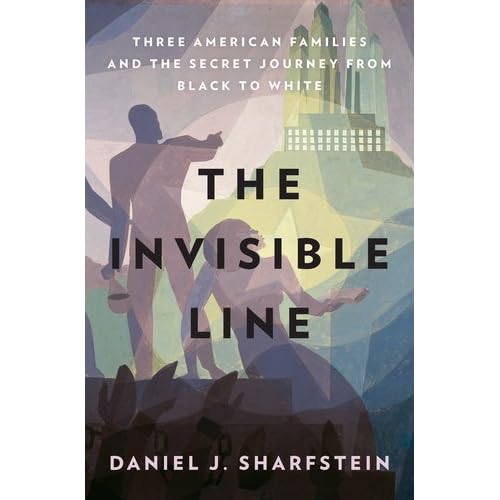
The Invisible Line

Written by Daniel Sharfstein
Penguin Group 2011

I tend to read more fiction than non-fiction, although I have been known to read a good biography. However, in the interest of full disclosure, I am a little bit of a history nerd and may have won some sort of award my senior year of high school to prove it. I saw this book featured on Goodreads as a giveaway, entered, and won a copy. Hooray for winning free books!
Professor Daniel Sharfstein of Vanderbilt University uses his book The Invisible Line to examine the lives of three families from the mid-1700s through the twentieth century. Each of these families is African-American, but passes themselves off as or is perceived as white at some point during their history.
This book starts off slowly, and it took me a while to get into it. It is sometimes confusing to keep track of which family is which, but this is easily remedied by checking the previous chapter or the family trees provided at the beginning.
The fascinating conclusion of Professor Sharfstein’s research is that the line between black and white is not as solid as we are taught in US History class. African-Americans fought on both sides during the Civil War. A little girl, despite looking white and having white ancestors back several generations, is expelled from a white elementary school. In several communities, families were as white as they behaved, or as white as their neighbors desired them to be.
“Like most Americans, they were taught to believe that the line between white and black is and always has been a natural barrier supported by science and religion and fortified by politics and law. Slavery and freedom, segregation and civil rights, whippings and lynchings, discrimination overt and subtle – the history of race in the United States had little to do with them. But all the while, a different story has been hiding in plain sight.”
The color line turns out to be a completely constructed – the same people are sometimes white and sometimes black, dependent on how they portray themselves or how their neighbors want their communities to appear. Many communities, having accepted the families as white for multiple generations, decided that exposing their neighbors was not worth upsetting the status quo.
Although this is a non-fiction book and these are historical accounts, Sharfstein writes like a novelist. His meticulous research results in fully-fleshed out characters that the readers come to care about. By focusing on three families throughout several hundred years, the reader gets both a wide view of issues of race and identity and a look at the day to day lives of people in different periods in American history. 

Friday, July 22, 2011

Literary Lindsey Elsewhere...

Thinking about reading Jonathan Franzen's novel Freedom? Check out my review at the Atlantic Highlands Herald here

Saturday, July 16, 2011

The Ten Year Nap

The Ten Year Nap by Meg Wolitzer
Penguin Group 2009

The Ten Year Nap is a compassionate, realistic look at the joys and pains of motherhood. Many books about mothers come off as trite and repetitive. Wolitzer portrays the difficulties of balancing raising children, pursuing a career and maintaining some semblance of self. But she shows the joys that occur as well, sometimes in the same moments.
This novel follows four women, good friends who are at different places in life. Amy is the mother of Mason, who is now in elementary school. Amy wonders what her purpose is now that her child is gone for most of the day. Jill and her husband Donald have adopted little Nadia. Jill is having a difficult time bonding with her child and making new friends in their new neighborhood. Roberta’s husband finds unexpected success with his career, leaving her jealous of his success and wondering what happened to the dreams she put aside for her children. Karen wonders if she gave up a passion for mathematics to please her parents, who had to work so hard to provide for their family.
Wolitzer focuses a large portion of the novel on each of these women, but she supplements it with quick looks into the lives of women of earlier generations, including the mothers of the four main characters, Margaret Thatcher and her assistant, and even Nadia Comaneci.  It often seems gratuitous when authors include so many characters, but in the case of The Ten Year Nap, it perfectly illustrates what former generations of mothers did for their children and the things that remain the same despite their efforts. This book doesn’t forget the fathers either. While this book is heavily about motherhood, we do get a brief glimpse of a father who wishes he could stay home with his children, but feels it is not an option available to him.
By employing a large cast of characters, Wolitzer doesn’t come across as judgmental about any of their parenting styles or decisions. This novel could be read by any mother at many different points in their lives, because in each reading they would find moments that are relatable. I read this book in one day and found myself laughing and relating to the characters.

Favorite Quotes:
“There was always so much to do. There were lists and plans and schedules that were essential to a well-run household and that were still laughably, almost hysterically, tedious. You, the brainy, restless female, were the one who had to keep your family life rolling forward like a tank. You, of all people, were in charge of snacks.”

"You stayed around your children as long as you could, inhaling the ambient gold shavings of their childhood, and at the last minute you tried to see them off into life and hoped that the little piece of time you’d given them was enough to prevent them from one day feeling lonely and afraid and hopeless. You wouldn't know the outcome for a long time." 

Welcome to Literary Lindsey

Hi friends!
Thank you for visiting Literary Lindsey. I'm going to tell you about some books I loved and some I hated and why, of course. I may opine on big news in the publishing industry. It's going to be fun, promise.
I'll be back soon!
~ Lindsey