Thursday, February 28, 2013

Review: 20 Under 40: Stories from the New Yorker

20 Under 40: Stories from the New Yorker
Edited by Deborah Treisman
Farrar, Straus and Giroux 2010
431 pages
From my shelves

20 Under 40: Stories from The New Yorker

It would be impossible to give appropriate attention to each of the stories included in this collection. So instead of attempting the impossible, I'm going to recap a few of my favorite stories and my thoughts about the book as a whole.

Birdsong by Chimamanda Ngozi Adichie presents a realistic and sympathetic picture of a young woman who never imagined she would become someone's mistress. As she notices a woman watching her at a stoplight, she fears it is the wife of her lover and thinks back on their relationship. Adichie has created a very relatable character - she reacts badly to being taken to secluded restaurants and to the way the driver snubs her. Her protagonist and her writing style are lovably prickly. We know that the relationship can only end badly, but she can't stay away from him and we can't stop reading about it.

There is a piece of Nell Freudberger's popular novel The Newlyweds that I found very well-written. I will be looking for the rest of the story. Amina meets an American man online and eventually moves to the US to become his wife. The dissonance between Amina's upbringing, where she is largely ignored or belittled by her family, and her new relationship with her husband is striking. I finished the piece wanting to learn more about Amina and George's new and unexpected relationship.

Dinaw Mengestu's An Honest Exit has much to do with the idea of storytelling. After our narrator misses class because of his father's death, he finds himself telling his students about his dad. He relates how his father escaped from the political strife of Ethopia to Sudan and eventually to London. In the telling (or re-imagining) of his father's story, he finds a sort of closure with the father he never felt he really knew.

As I read over the list of authors featured here, it was interesting to note how many of them have had popular and/or critically acclaimed books published within the past few years. Writers in this collection include Tea Obreht, Nicole Krauss, Karen Russell, and Jonathan Safran Foer. It was also fun to see that a few of the short stories became pieces of those very novels. I recognized Krauss' selection because I  read and enjoyed her novel Great House. 


Short story anthologies are intriguing to us because we hope to find new beloved authors. However, the problem becomes the sheer number of stories in a book. It's difficult to remember which story or author you really liked when you are twelve stories into the anthology.
Do you like reading short story anthologies?
Do you have a specific method for keeping track of which authors you admired?
Which authors have you discovered through short story collections? 

Wednesday, February 27, 2013

Wednesdays with David: Pippi Longstocking

Pippi Longstocking
By Astrid Lindgren
Puffin 1945
From the library 


The story: Pippi is a little girl who lives all alone in a big house - well, not alone: she has no mother and her father is the king of a far-away cannibal tribe but she does have a beloved horse and monkey. When two neighboring children  meet her, shenanigans ensue as Pippi tries out school for the first time, dodges some policemen, and celebrates her birthday.

Mama opines: Well, this is a first for us. We got this book from the library and read the first few chapters. That night, David asked to take it up to bed with him and I said yes. The next day, I asked if he wanted to read a few chapters. He told me no - he finished it the night before!
I'm still getting used to having a reader...I was a bit sad he finished it without me because I've forgotten how the book ends!
This book is a lot of fun. Pippi and her friend get into a lot of trouble, but there is a serious lack of respect for rule and authority. You have to gauge if your child is the type to retort that they don't have to follow the rules because Pippi doesn't and that they are going to go live without a mommy or daddy too....If that's the case, you might want to skip this one.

Thoughts from David: I like it because Pippi Longstockings lives without any daddy or mommy and she tricks two policemen! Then she climbs a tree to trick the policemen again.
Favorite part: When Pippi climbs the tree.

Happy Reading! 

Tuesday, February 26, 2013

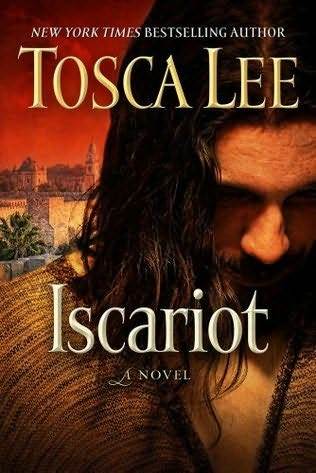
Review: Iscariot

Iscariot
By Tosca Lee
Howard Books February 2013
320 pages
Received for review

Iscariot

When we read through the Bible, there is one person who is more reviled than any other. We have a hard time wrapping our minds around a man who could travel for years with Jesus as his friend and disciple and then betray him for thirty pieces of silver. It's easy for us to forget that Judas Iscariot was a person, just as we are, with strengths and weaknesses, triumphs and failings. Tosca Lee has not forgotten this and in her latest novel Iscariot, she gives us a compelling picture of what the story of Judas could have been.

We first encounter Judas at the end of his life, where he is thinking back over his life and trying to determine how he has ended up here. From there, we are taken back to his childhood. Judas is a man whose heart has been broken many times over. He has lost his father, his brother, and his wife to Roman violence and is looking for a leader who will bring justice and peace to his land. He initially approaches both John the Baptist and Jesus himself to find out if they will join his group of zealots in reclaiming their homeland. But Jesus is so different from what Judas expected that he can't help but follow him.

Lee accomplishes two difficult things in this novel. First, her research is an effortless part of the story. She writes in the author's note that the book was originally twice as long and extremely research heavy. In revising the book, she cut out a lot of the facts and focused on the character of Judas. But we really experience the uncertainty of living during this time period for the Jewish people and the complicated hierarchy of Jewish tradition.

The second thing Lee achieves is making one of the most hated men in all of history interesting and even likable. It's easy to think of Judas as someone who is evil and conniving from the beginning. It's much more challenging to think of him as a man who truly loved Jesus and considered him his best friend and teacher. As events progress, Judas is faced with a dilemma. He can't see a way in which things end well for Jesus, for the other followers, or for himself. In Ms. Lee's version, Judas makes what he views as the best of some very bad options. That choice spins wildly out of control with consequences that Judas never foresaw. While I don't know that I buy the sequence of events, I can't deny that reading this book made me dramatically rethink the way I perceive Judas.

This would be a really great book to read right now during Lent as many of us are thinking about the last days of Christ. You know that a book is well-written when you know how it will end, but can't help but read a few more pages. Tosca Lee has written a very engaging book that will make readers reconsider the way they see Jesus and the way that they think of the man who has come to represent the very worst of humanity.


To the guys and gals of the FTC: I received this book from The DeMoss Group in exchange for an honest review. Thank you, Adrienne! 

Sunday, February 24, 2013

It's Monday and it's been a great weekend


Hello, readers! How ya doing? This was a good week and a fantastic weekend. We've been working on organizing the house and getting the nursery ready for our May baby, since May is coming pretty soon! The husband finished painting the nursery on Saturday and it looks wonderful. On Sunday, we celebrated my dad's birthday and it was so nice to have the whole family together. We stopped to see the husband's family on our way home too, so it was a family-filled day. 

Reading-wise, I am still working on Catch-22. I'm trying to read 50 pages a day, so I should finish it this week. I started reading Seraphina in the meantime and powered through it in two days. I love that kind of read! 

Read This Week:
Seraphina (Seraphina, #1)
By Rachel Hartman 

Posts from this Past Week:

Still Reading:

Up Next:
The Red Garden
The Red Garden
By Alice Hoffman


What are you reading this week?

Thursday, February 21, 2013

Review: Mr. Penumbra's 24 Hour Bookstore

Mr. Penumbra's 24 Hour Bookstore
By Robin Sloan
Farrar, Straus, and Giroux October 2012
304 pages
From the library 

Mr. Penumbra's 24-Hour Bookstore

I have committed the most terrible sin of book bloggers. I finished this book back in October, according to my handy dandy Goodreads account. I took some notes and then I thought I would sit and ruminate. Well, it's four months later and I don't remember this book quite as well as one might hope. That being said, I'm just going to throw out a few things I do remember because you've probably read the book by now anyway!


Clay Jannon has lost his job as a designer and media guru for a bagel company. He wanders the streets of San Francisco looking for work when he spots an ad in a window. He enters the store and has his first meeting with Mr. Penumbra, proprietor of Mr. Penumbra’s 24 Hour Bookstore. Clay is hired as the night clerk and settles in for some long, quiet nights. But he quickly realizes that there are only a few popular books and most of the books are unheard of titles  borrowed by mysterious regular patrons. What is the real story at this bookstore?

Mr. Penumbra’s 24 Hour Bookstore might best be described as a zany romp. It begins in a place that is familiar to many of us – a dark, dusty, second-hand bookstore. “The shelves were packed close together, and it felt like I was standing at the border of a forest – not a friendly California forest either, but an old Transylvanian forest, a forest full of wolves and witches and dagger-wielding bandits all waiting just beyond moonlight’s reach. There were ladders that clung to the shelves and rolled side to side. Usually those seem charming, but here, stretching up into the gloom, they were ominous. They whispered rumors of accidents in the dark.” Just when you might start to feel comfortable, Mr. Sloan whisks you off to the inner sanctum of Google and an underground meeting place for a secretive group of bibliophiles.

This book is fun – a lot of fun – and it doesn't take itself too seriously. In spite of that, it manages to bring up some important questions about our seemingly polarized book culture. How does a book lover appreciate both a Kindle and an antique hardcover? Is there a place for the old and the new?

Sloan writes characters who are smart and recognize their own intelligence. This book feels like a smart author writing intelligently about smart people and relevant issues. His characters are young entrepreneurs, computer programmers, and artists. They learn quickly and always banter with wit. Kat Potente, Clay’s lady love, says, “This is going to sound strange, especially because we just met. But I know I’m smart.”
“That’s definitely true –“
“And I think you’re smart too. So why does that have to end? We could accomplish so much if we just had more time.”


So, to bring some sort of conclusion to my four month old ramblings...If you love books about books and a fun story and you somehow haven't read this one yet, get thee to the library and give it a whirl! 

Wednesday, February 20, 2013

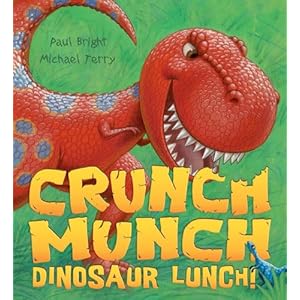
Wednesdays with David: Crunch Munch Dinosaur Lunch

Crunch Munch Dinosaur Lunch
By Paul Bright and Michael Terry
Good Books 2009
From the library


The story: Ty is a big, fierce tyrannosaurus who is about to go get some breakfast. His efforts are thwarted by his baby sister, Teri, who shows up at the worst possible moment for a snuggle. Will Ty ever get something to eat or will a threat to his baby sister make him rethink just how annoying she is?

Mama opines: I have to confess that I picked this up because it's about a dinosaur and his little sister. I obviously don't expect that David will have a dinosaur sister in May, but it doesn't hurt to read as many brother/sister stories as we can get! 

This book hits a great balance between a sibling's frustrations and a fun book about dinosaurs. 

Thoughts from David: I like it because he roars his terrible roar. I like it because he stomps through the swamp.
Favorite part: When he says, “I’m biggest, I’m baddest, and I need a treat! Diplodocus steak looks tasty to eat!" 

Happy Reading!

Tuesday, February 19, 2013

Review: Open City

Open City
By Teju Cole
Random House February 2011
259 pages
From the library
Pen/Hemingway Award in 2013, #1

Open City

Julius is a young doctor in New York City, completing his residency in psychiatry. He begins a routine of walking through the city each day after his shift is over. During these walks, he runs into old friends, meets new acquaintances, thinks about his life so far, and wonders about the ways in which we are both connected to each other and utterly alone. 

From the first sentence, you can tell that Teju Cole's writing style is a bit different. The first sentence reads "And so when I began to go on evening walks last fall, I found Morningside Heights an easy place from which to set out into the city." This is a story starting in the middle. Although all stories start (and end) in the middle of someone's life, I was intrigued by Cole's decision to bring attention to it.

This is not a plot-heavy novel. Julius wanders through his thoughts at the same speed that he meanders through the streets of NYC. So it may not be the book for you if you like a story that will keep you on the edge of your seat. But there are many other reasons to read Open City - this book is like a walking tour through the city complete with lessons in music, history, and art alongside insightful observations about life and community. "And, before that? What Lenape paths lay buried beneath the rubble? The site was a palimpsest, as was all the city, written, erased, rewritten. There had been communities here before Columbus ever set sail, before Verrazano anchored his ships in the narrows, or the black Portuguese slave trader Esteban Gomez sailed up the Hudson; human beings had lived here, built homes, and quarreled with their neighbors long before the Dutch ever saw a business opportunity in the rich furs and timber of the island and its calm bay. Generations rushed through the eyes of the needle, and I, one of the still legible crowd, entered the subway. I wanted to find the line that connected me to my own part in these stories."

Julius has no familial ties in America, as he emigrated from Nigeria. He spends a great deal of the novel thinking about connections and the way it is easy to strike up a conversation with someone he has never met while realizing that he hardly knows the people he would call his friends and mentors. Early in the book, he runs into his next-door neighbor and is shocked to find that his neighbor's wife had died several months ago. "A woman had died in the room next to mine, she had died on the other side of the wall I was leaning against, and I had known nothing of it....That was the worst of it. I had noticed neither her absence nor the change - there must have been a change - in his spirit. It was not possible, even then, to go knock on his door and embrace him, or to speak with him at length. It would have been false intimacy."

It can be hard at times to really connect to our narrator. Perhaps this is because he has so few attachments and so we view him through his thoughts on things instead of people. There is a moment in the story where something is revealed about his past that threatens to unravel any perception the reader has of him. Instead of confirming or denying this, the author and Julius himself just leave it alone. In addition, the ending is abrupt. This book just seems to end in the middle of a thought.  But I suppose it all relates back to the idea of any story just being a snippet of a life.

Open City is a really interesting read. While it doesn't have a breakneck plot or really developed characters, it does ask a lot of important questions about how well we can know other people in our community and how much we reveal of ourselves to others. If you don't mind a slower, thoughtful read, I would recommend that you pick up this PEN/Hemingway Award winner.