Showing posts with label Rebecca Makkai. Show all posts

Thursday, July 19, 2018

Review: The Great Believers

Yale Tishman is at a turning point in his career. If he can get a group of paintings donated to his Chicago gallery, it will be his biggest success yet. But his personal life is not as hopeful--his friends are dying from AIDS and no one knows how to grieve or who will be the next to be diagnosed. He finds comfort in the unlikely friendship of his friend Nico's younger sister Fiona. Thirty years later, Fiona is desperately searching Paris for her daughter. She thought Claire was lost to a cult, but now she will do anything to reconnect with her daughter and try to make amends for the ways she failed her.

I've been intrigued by Rebecca Makkai's writing for a long time. Not every story of hers works for me, but she weaves some kind of literary magic that makes me willing to try again. With this book, she has written herself into a tough situation because every book about a group of gay friends finds itself compared to the devastating A Little Life. The wonderful news is that this book holds its own--there is a perfect balance here between a specific moment in time and the intimate details of any person's life.

Both Yale and Fiona are incredibly invested in what is happening around them, as friends, relatives, and lovers are dying from AIDS. They show how life continues in spite of loss and tragedy, because there are fights with family and you still have to make that appointment and get to work on time. But there is a specter hanging over everyday life as characters wonder if a cough is just a cough or feeling tired means that something insidious is inside your body. The costs are more than physical--there is immense pressure on the ones left behind, the ones who say goodbye over and over again and must keep the memories of their friends alive.

In my reading lately, I'm finding many good books where I am excited to keep reading, anxious to find out what happens to the characters, and invited into another time and place by careful writing. But the books that stand out for me are the ones that are just enough--the author takes us into someone's life and knows when to close the curtain and force us to go back out into the world. The Great Believers is one of those stories. I spent the perfect amount of time with Yale and Fiona and I grew to care for them. Now I am ready to leave them behind and return to my own life, prepared to be a bit kinder and pay attention a bit more because our time with the people we love is a finite gift.

The Great Believers
By Rebecca Makkai
Viking June 2018
432 pages
Read via Netgalley

Also by Rebecca Makkai: The Hundred-Year House and The Borrower

Thursday, August 28, 2014

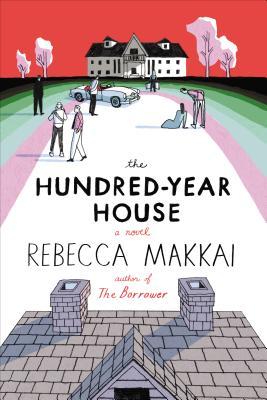
Review: The Hundred-Year House

The Hundred-Year House
By Rebecca Makkai
Viking Adult July 2014
352 pages
Read for review via Netgalley 

The Hundred-Year House

In 1999, Zee and Doug return home to Laurelfield, Zee's family estate. It is the last place they want to be, but financial woes force them to live in the carriage house. Zee is a professor with Marxist leanings and Doug is a writer. At least he hopes to one day finish his book on little-known poet Edwin Parfitt, but for now he is writing formulaic books for tween girls (without his wife's knowledge).

Laurelfield has always been a place of mystery - Zee's great-grandmother committed suicide under strange circumstances, an artists' colony stayed at the estate but has few records, and unexplained noises bump in the night. But it seems that the problems are not contained to the past. When another couple moves into the carriage house with Zee and Doug, tensions rise as families feud, flirtations begin, and people are injured on the grounds of the beautiful and unsettling Laurelfield.

The Hundred-Year House is multifaceted. It begins at the end of the twentieth century and then goes back in time as we find some answers and encounter a whole new bunch of questions. We encounter Zee's mother Grace again in 1955 as a newlywed. Her marriage is troubled, to say the least, and the anger and sadness become claustrophobic. Twenty-six years earlier, the estate is home to a zany and fascinating bunch of artists - painters, musicians, and writers, including Edwin Parfitt himself. This is the portion of the novel that is the most comedic, as the artists band together to save the colony from closing. 

The atmosphere built throughout this novel is incredible. The estate itself feels haunted. Everyone who is there feels like the spirits of past inhabitants remain and questions are still unanswered. They also feel a distinct sense of destiny and it is clear that some of them are destined to be there, while others are not welcome. Makkai uses a subtle touch throughout this book. You can feel the unease as the characters start to wonder how many of their problems are self-made and how many are caused by forces beyond their control. 

Unfortunately, there is just too much going on here. There are too many characters, too many time periods, and too many themes. It is difficult for the reader to focus on any of them for long because it's only a matter of time until you get thrown into a whole new situation. There is a certain kind of reader who will enjoy this box within a box approach to storytelling, but I found it simultaneously overwhelming and underwhelming.

The Hundred-Year House might be called light horror. The creepy air around Laurelfield is undeniable and Zee even teaches a course about ghost stories, but this isn't really about ghosts. It is a literary story about destiny and how our choices can reverberate for centuries to come. This book would be a great pick for a reader who wants to feel a little chill in the air without suffering a sleepless night. 


My review of Makkai's The Borrower

Thursday, November 3, 2011

Review: The Borrower

The Borrower: A Novel 
By Rebecca Makkai
Viking June 2011


Lucy Hull is a small town children’s librarian with a big love for books. One of her favorite library patrons is ten year old Ian Drake. His imagination and spirit are compelling, even as his strictly evangelical mother severely limits his selection of books. Lucy has been clandestinely sneaking the boy books his mother will not allow him to read. She worries about him, fearful about his relationship with his parents and worried that Ian is being sent to a local program that promises to ‘un-gay’ children.

One morning, she comes into the library to find Ian. He has run away from home and camped out in the library. She offers to drive him home. Ian accepts, but then refuses to give his address and leads her on a wild cross country adventure.

This is a great book for people who love books. The references are endless and will make you stop to fondly remember the books that you loved as a child. Chapter titles are often book titles or literary allusions. The novel as a whole is enjoyable, but I think Ms. Makkai boxed herself in with her plot. Once Lucy has (for all intents and purposes) kidnapped Ian, the reader knows that there are only a limited number of options for an ending. Even Lucy knows that their adventure cannot continue indefinitely:

“I was surprised-and surprised to be surprised-but I couldn’t figure out what it was that I’d expected. Somewhere in the back of my mind there had always been a fantastical and illogical ending to the story, as crazy as Ian’s story about his grandmother, and if only I had bothered to examine it first, we wouldn’t be here. I’d forgotten that all runaway stories end like this. Everyone goes home. Dorothy clicks her way back to Kansas, Ulysses sails home to his wife, Holden Caulfield breaks into his own apartment. Huck didn’t go home, at least-but what happened to Jim? Probably something terrible. I couldn’t even remember.
What happy ending could I have been nursing, this whole time? It lurked there like a dream, half remembered.”

Perhaps the biggest hurdle to get over is that nothing really seems to change. If this novel is meant to be a great literary adventure, something must happen as a result of the journey. But in The Borrower, it seems that little changes for the main characters in the wake of their adventure together.  This frustrated me a lot – why in the world had they gone through this whole thing if they were only to end up (situation-wise if not geographically) right back where they had started? I liked this book, but ultimately didn’t adore it the way I had hoped that I would.


All of that being said, I have to leave you with this ridiculously wonderful quote about Lucy’s personal book collection:

“Thus Nabakov lived between Gogol and Hemingway, cradled between the Old World and the New; Willa Cather and Theodore Dresier and Thomas Hardy were stacked together not for their chronological proximity but because they all reminded me in some way of dryness (though in Dreiser’s case I think I was focused mostly on his name); George Eliot and Jane Austen shared a stack with Thackeray because all I had to his was Vanity Fair , and I thought that Becky Sharp would do best in the presence of ladies (and deep down I worried that if I put her next to David Copperfield, she might seduce him). Then there were various stacks of contemporary authors who I felt would get along together at cocktail parties, and there were at least three stacks of books I personally loathed but held on to just in case someone asked me to loan them a page-turner about a family of circus performers, or an experimental novel about a time-traveling nun. I’d hate to have to say that I knew the perfect book but I’d just given it away. Not that people often asked.”