Showing posts with label Geraldine Brooks. Show all posts

Tuesday, December 1, 2015

Review: The Secret Chord

He is one of the most beloved men in the Bible. He is the boy who slew the giant, the king who danced before God, and the man who grieved for his sins and the loss of his son. David, the King of Israel, was both revered by his people and reviled by the people whose kingdoms he conquered. When David asks the prophet Natan to compile a history of his life, he discovers hidden chapters as well as triumphs and tragedies he could never have anticipated. David is desperate to be known not just as a name, not just as king, but as a whole man who had successes and failures.

Natan and David share a special bond. David spared Natan after he took revenge on his family and instead took him in as a part of his entourage. He soon discovers that Natan hears directly from God, who has quite a few things to say to David about his life and the future of his kingdom. Natan knows David as few other people do, but he is still surprised by the brutal choices he makes to hold his kingdom and his reign together. He is a bold leader, but he can also be terribly selfish and the power and glory of being a king goes to his head all too often.

In one important scene, David dances before the holy Ark of the temple. That joy is not often to be found in the pages of The Secret Chord. As witnesses to David's life, we are too late to witness the moment of triumph when he is crowned king and we do not see the joy of meeting his children or the happy private moments with any of the women he loved. This is a dark book, full of battles, deception, and pain felt by David, Natan, and pretty much every other character to appear in this story. The continuous feeling of darkness can make it a difficult book to read in some sections and without the levity and joy, it can be hard for the reader to believe they should care for this hardened and stone-faced king.

Geraldine Brooks is a very gifted historical fiction writer and she is unafraid to tackle any topic, era, or person. At this point, her books have been about the plague, Louisa May Alcott's famous March family, and the first Native American to graduate from Harvard College. While this is not my favorite of her novels, I admire her love for history and her ability to take moments and people out of the archives and bring them to fascinating and nuanced life.


The Secret Chord
By Geraldine Brooks
Viking October 2015
302 pages
Read via Netgalley

Monday, January 5, 2015

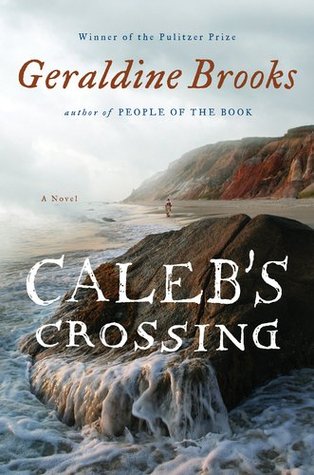
Review: Caleb's Crossing

Caleb's Crossing
By Geraldine Brooks
Viking May 2011
306 pages
From my shelves


Caleb's Crossing

In 1665, a man from the Wampanoag tribe became the first Native American graduate of Harvard College. That is the only record that history leaves us about this person. But Geraldine Brooks has taken this tiny piece of history and created a rich story. Our narrator is Bethia Mayfield, a girl who is growing up as the daughter of a Puritan minister. As she wanders around their island home, searching for knowledge and freedom, she becomes friends with Caleb from the Wampanoag tribe. Although their lives look radically different, they find parallels in their struggles between a thirst for knowledge and a respect for tradition, and the pull of their families and the need for freedom.

It is no surprise to anyone who reads this blog that I am a huge fan of Geraldine Brooks and her historical fiction. She took readers back to 1665 and a small village that quarantined itself to prevent the plague from spreading in Year of Wonders. People of the Book had us imagining the origins of the Sarajevo Haggadah and March threw everything we thought we knew about our beloved Jo, Amy, Beth, Meg, and their parents right out the window. Ms. Brooks has a gift for fully inhabiting a time period and a set of characters, even if she is working from just one letter or historical document. I was equally excited and apprehensive to read Caleb's Crossing, because it is the last novel by Brooks that I had to read. 

By telling Caleb's story through Bethia's eyes, we get to see twice what it means to be a second-class citizen. Both characters are seen as less-than, as an other in a society that gave respect based on your heritage as a white man. This is especially frustrating when Bethia and Caleb are contrasted with Bethia's brother, Makepeace. He gets every opportunity simply because he is a white male, although he is the least intelligent of the three. 

Perhaps the trouble with this novel is that Brooks is true to her time period. As modern readers, we can see the potential of both Caleb and Bethia. But we know, as they do, that they are ultimately destined to live and die within the cruel constraints of their time and place. As we reach the end of the book and Bethia looks back at her decisions and the sacrifices she made, she almost has no choice but to be grateful. What else can she do as a woman of the 17th century? 

I enjoyed reading Caleb's Crossing. As usual, Ms. Brooks brings history to vivid life and makes readers think about the differences between the past and the present. But it took me a while to really care for these characters. Readers new to Brooks' novels would be better off starting with one of her earlier novels. 

Friday, June 28, 2013

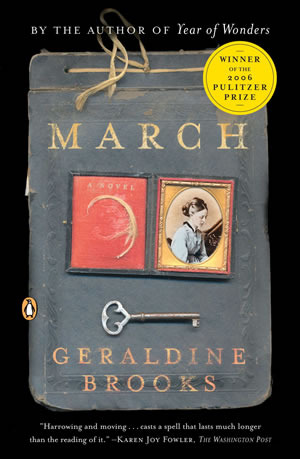
Review: March

March
By Geraldine Brooks
Penguin 2005
280 pages
From my shelves

March

Millions of young readers have fallen in love with the little women of the March family and the novels that tell their story. But Little Women focuses heavily on the children themselves. While Meg, Jo, Beth, and Amy grow and change, their father is absent for most of the book and their mother is presented through the worshipful eyes of children. In March, Geraldine Brooks imagines the patriarch of the March family as he grows up, falls in love with Margaret Day, and learns about the terrible realities of slavery and war.

When you approach beloved characters and give them a rewrite, you can expect to get some angry responses. Many readers hate the things that Brooks does with the beloved characters of Marmee and Mr. March. But I think she has made them human. In Little Women, Marmee is endlessly patient and loving which is, of course, how we like to remember our mothers. But in this version of their story, Marmee has a terrible temper and is not afraid to use it to stand up for what she believes to be right and alienate people in the process. Mr. March has character flaws as well - he is often oblivious to the feelings of others and acts without considering the consequences for those closest to him. Their marriage is not without turmoil, especially when Marmee learns the details of her husband's past and his true experiences during the war.

Brooks is an incredible writer. She creates rich characters and gives the readers a very true sense of time and place. You may feel like you know about slavery and the Civil War but this author will make you feel anew just how dark and awful that time period was. I've read many books about this era in our country, but still felt like setting down the book multiple times because I was overwhelmed by the cruelty of slaveholders and soldiers and the hopelessness of slaves and the people whose lives were ruined by a terrible war. 

March  is a slight book, but it's not a quick read. Ms. Brooks brings a dark time to life with terrible clarity while focusing on one flawed man, one woman trying to hold a family together, and one marriage that struggles to survive the turbulence of a long time apart and closely held secrets. If you love Little Women, read March to find new depth in a favorite story. If you thought that Little Women was a simplistic book for children, read March to discover what really happened to the parents of one of literature's most beloved families.


Other books by Geraldine Brooks: Year of Wonders, People of the Book 

Tuesday, February 12, 2013

Review: Year of Wonders

Year of Wonders
By Geraldine Brooks
Penguin Books 2001
304 pages
From my shelves

Year of Wonders

Anna Frith is a young widow attempting to raise her sons in a small village. When a tailor comes looking to rent a room, she sees an opportunity to make some extra income for her family. Little does she know that this tailor, who will become so dear to her family, will also be the one to unknowingly bring a terrible plague to their village. As people begin to die in their small town, the vicar makes a bold decision and decides that they will quarantine themselves for the good of the outside world. Anna begins to work with the vicar and his wife to bring healing and hope to the people of their village and discovers that she can do more than she ever imagined. 

Geraldine Brooks has written another beautiful story with Year of Wonders. As usual, she writes from true events. In 1665, the residents of the tiny village of Eyam, Derbyshire decided that they would seal their village off from the outside world in order to stop the spread of the deadly plague that had started to infect them. In Brooks' very capable hands, the story is, in turns, beautiful and heartbreaking. How and why do we continue to live when there is nothing left to live for? Anna is a compelling narrator and someone who truly evolves through her experiences. The vicar's wife takes Anna under her wing and teaches her to read. Together, the women begin to delve into the art of healing in the hopes of bringing some comfort to their dying friends and neighbors. I think this book strikes exactly the right chord between the horror of not knowing who is next, the pain of losing people who you love, and the exhaustion of trying to put one foot in front of another in this bizarre new existence. 

As I read this book, I thought about our seeming obsession with books about the end of the world in modern times. We read (and worry) about zombies or a nuclear attack or the sun no longer warming our planet. We wonder what we would do in those seemingly impossible situations. But I think we sometimes forget that it has seemed like the end of the world many times before. For the people living in a city wracked by disease or war or famine, it seems like life cannot and will not go on. I think our fear of a devastating end doesn't change, but the things we are afraid of do evolve with time and technology. 

My only complaint about this powerful little novel is the ending. It is a confusion that appears to be shared by many readers. Without giving it away to those of you will read this book, I will just say that Brooks radically shifts the trajectory of the story and throws in new characters and locations. The change is abrupt at best. I wish the book had ended differently, but I am still glad I read it and experienced Anna's growth and the terrifying lows and inspiring highs that people can reach in the very worst of situations. 

Thursday, November 29, 2012

Review: People of the Book

People of the Book
By Geraldine Brooks
Penguin Books 2008
372 pages
From my bookshelves

People of the Book

Hanna Heath is surprised and pleased when she is offered an incredible opportunity: she is asked to travel to Sarajevo to examine the famous Sarajevo Haggadah. This book is unique among Jewish volumes because it is one of the first to include images alongside its stories from the Torah. Hanna begins the painstaking work of discovering the potential origins of the book. As Hana finds small pieces of evidence, we are taken back into history to meet the men and women who made and preserved this remarkable book.

The Sarajevo Haggadah is a real book and a mystery among scholars. Ms. Brooks has imagined a possible history by having Hanna discover a clue or anomaly and then giving us the story behind it. The stories are beautiful and heartbreaking and I was constantly impressed by Brooks' ability to bring all of these characters in all of these different places and times to vibrant life. Lola, a Jewish freedom fighter who is taken in by a Muslim family; Giovanni Vistorini, the Catholic priest with the power to save or destroy the Haggadah during the Inquisition; and the young artist who creates the book are just a few of the characters we meet on these pages. There is something incredible about the importance each person grants the Haggadah and the ways in which they fight to protect it.

As Hanna pieces together the history of the book, she also makes important discoveries about herself and her family. Some reviewers find Hanna to be the weak link in this book, but I found her an interesting character. As she becomes close to the the director of the library museum, she finds her ideas about relationships and trust rapidly changing. Her already tenuous bond with her mother is tested when Hanna discovers that people in the present can keep secrets just as devastating as the ones that threatened and preserved the Haggadah.

People of the Book is, like many books that I adore, at its core about our relationship with this unlikely combination of paper and ink, pictures and glue. Books are important, and the people who realize that are our kindred spirits regardless of whether they are real life friends or just people we meet on a page. This is a gorgeous book that reveals the importance of words, faith, and love. It's one I will be returning to time and again.